Showing posts with label Thai Food. Show all posts

Tuesday, October 07, 2008

Thai Coconuts

Coconuts are the seeds that grow coconut trees. Given time, a coconut will sprout and take root. The juice and flesh of the coconut provide water and fertilizer to grow the young new tree. Coconut trees are grown throughout Thailand on raised beds with irrigation canals on each side. In some places, trained monkeys even harvest the coconuts. Coconuts provide juice to drink, flesh for eating or for making coconut milk, and play a role in many non-food items as well.
Coconut trees are treated as propitious in Thailand. They are often included in gardens along with other trees that include the word "ma" - for example, ma muang (mango), ma la gor (papaya) and ma prao (coconut) - to bring good luck and basic prosperity. Oil from coconuts is produced by first drying the flesh for several weeks and then pressing it. Sugar is made from sap of the seed pods of the coconut. Sap is boiled and set, and a light brown sugar (palm sugar) results.


Fresh coconut milk is widespread in Thailand. Thais often buy it freshly pressed (the first pressing yields creamy coconut milk, the second is more like water with nutrients). Coconuts are sometimes roasted which concentrates the sugar to make the flavor sweeter. Coconut milk is used in some Thai soups and curry dishes (such as green curry, massaman and panaeng curry) and can be a key ingredient in harmonizing a tasty flavor and consistency.
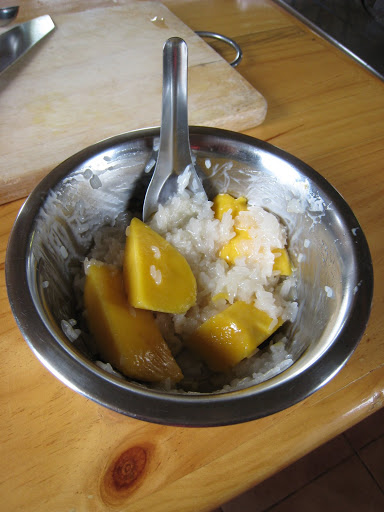
Coconut milk is used to make the sauce poured on mango with sticky rice. It is also used with black sticky rice desserts. In Thailand, one also often finds for dessert what appears like a buffet choice: many containers gathered together of freshly prepared fruits as well as items like lotus seeds or corn.

The customer selects from some of the containers and these are put together over crushed ice and a fairly sweet liquid containing coconut milk. Speaking of desserts, another favorite is coconut ice cream - contrasted with making it from dairy products, a delicious version can also be found which is made from coconut milk and cream. It is slightly icy and some versions include small pieces of sweet coconut meat. Some Thai restaurants in the US have this. And of course on cooking, second best to fresh coconut milk is canned coconut milk.
In Thailand, one can also buy young coconut from stands on the street where the vendor will chop open the coconut for you and you can enjoy the fresh coconut and juice. There are a variety of other tasty snacks and appetizers as well. There are many examples of Thai food with coconut, which combine potential health benefits with enjoyable snacks and dishes. Coconut contains substances such as lauric acid known for benefits such as anti-microbial effects. Two other positives are that coconut oil does not contain trans fatty acids, and most of its saturated fat consists of medium-chain fatty acids rather than long-chain, which means it gets digested and used more easily and is less likely to be stored long-term as fat.

Interestingly, the fat and oil of coconuts contain many beneficial aspects. In addition to antiviral, antibacterial, and antiprotozoal functions associated with lauric acid, natural coconut fat helps normalize body lipids, protects against liver damage, and perhaps most importantly, improves the immune system's anti-inflammatory response. Good saturated fats also contain micronutrients and vitamins that are vital to metabolism. Coconut milk helps balance cholesterol and metabolism, and provides valuable fatty acids. The positive aspects of coconut and palm oil generally are likely part of the reason Thais have such a low rate of heart disease.
There are non-food uses from the coconut tree as well. Dried shells are used in making kitchen utensils such as spoons, as well as other household items such as lamps. Some musical instruments are also made with the shells. The fibrous outer layer of the coconut is also used for fuel as well as roofs. It is also a component for cosmetics and soaps.
Thai medicine also makes use of the coconut (tree, leaf, shell, juice). To conclude, suffice it to say there are a rich variety of food and non-food uses for coconuts!

Mouth-Watering Thai Desserts

Thai cuisine is famous for its intriguing delicacy and spiciness. However, Thai desserts have been overlooked. The three Thai desserts famous outside of Thailand are mango with sticky rice, deep-fried bananas and coconut ice cream. There is a broad tradition of desserts in Thailand over the centuries which offers many ideas and choices.
What are the common desserts that Thais eat? Thais loves desserts (called Khanom in Thai). The well known dessert is Mango with Sticky Rice, but it is a seasonal dessert, around April to June. Deep-fried banana fritters (Gluay Tod in Thai) or bananas in coconut milk (Gluay Buat Chee) are also well known desserts in Thai restaurants in the U.S. In Thailand, there are all kinds of desserts, both non-seasonal and seasonal, from deep-fried to steamed. Some of the most common Thai desserts include the egg-yolk desserts; Thong Yip (Pinched Gold), Thong Yod (Drop of Gold) and Foi Thong (Golden Threads). Thong simply means Gold. The color of these three desserts is a yellow-like golden color from the egg yolk, and is used to signify prosperity and auspiciousness. These "three musketeers" desserts are often used in wedding ceremonies or commemoration of a new house as well.


Khanom Chan or layered dessert is another common dessert. The name of the dessert comes from the fact that it has 9 layers with color variations. The dessert uses only 2 colors: white and a light tone of a color like green or purple. White is used in every other layer. This dessert is also used in important ceremonies like weddings or the grand opening of a new business. Thais believe the number "nine" is an auspicious number which represents progress and advancement.


One of my favorite desserts is Luk Choob. Made from mung dal beans, this dessert is a collection of miniature replicas of fruits and vegetables. The fruits and vegetables are colorful and glossy, artistically carved, and styled with vegetable dyes and glazed in the gelatin-like agaragar. Bua Loy Benjarong is another interesting dessert. Bua Loy Benjarong is gluten balls in coconut milk, a dish that has been with Thailand for over 200 years. The little balls, the size of the tip of the pinky, are made from sticky rice flour mixed with natural colors. Benjarong refers to 5 natural colors: green (from pandanus leaf), purple (from taro and Chitoria Tematea Linn flower), yellow (from pumpkin), blue (from Chitoria Tematea Linn flower) and white (from jasmine water).
Additionally, tapioca and black beans in coconut milk (Sakoo Tao Dum), coconut custard in a hollowed pumpkin (Sangkhaya Fak Thong), grilled coconut cakes (Paeng Jee), mung dal beans and lotus seeds with coconut topping (Tao Suan Med Bua) are desserts, to name a few, that are common in Thailand.

Thai desserts have always been a part of Thai culture. They reflect caring, patience and an enjoyable way of life. Unfortunately, as time passes, some of the traditions and beliefs are being forgotten in Thai society, although most kinds of desserts still exist. Their tempting and satisfying tastes leave a lasting impression - which is in turn an integral part of why Thai desserts have not been lost with time.

Fragrance unique characteristic of Thai desserts

Fragrance is another unique characteristic of Thai desserts. There are many ways of making good aromas with Thai desserts but the most common ones are using jasmine flowers (Dok Ma Li), rosa damascene (Dok Ku Laab Mon - roses family), cananga odorata flowers (Dok Kra Dang Nga) as well as fragrant incense candles (Tien Ob).

Since the old days,

Thais love using jasmine water in desserts because of its aroma. Thais would pick jasmine flowers around 6pm and gently rinse with water so that the flowers do not get bruised. The jasmine flowers (Dok Ma Li) are then soaked in water with a closed lid, and left until around 6am-7am the next morning. The resulting scented water is then used to make the dessert. Keeping the jasmine flowers for more than 12 hours will start to bruise the flowers and the water will not have a good aroma.

Rosa damascene (Dok Ku Laab Mon) is used in a different way. Thais only use the pedals. Each pedal is torn into 2 or 3 pieces and then placed in a closed container that has a dessert in it for a certain period of time, usually overnight. For cananga odorata flowers (Dok Kra Dang Nga), Thais first burn them with a fragrant incense candle, and then place only the pedals in a closed container that holds the dessert. For some desserts, burning fragrant incense candles next to desserts in closed containers will be enough to give the desserts an intricate aroma.

List of Colouring For Famous Thai Dessert

Thai desserts are well known for their intriguing light tones. Generally the colors used to attract people are made from natural flowers or plants. The following are examples of the most common color sources used in Thai desserts:
Pandanus leaf (Bai Toey): giving a dark green color;


Spathe of coconut or palmyra palm leaf (Kab Ma Prao or Bai Taan) : giving a black color;
Turmeric (Kha Min): giving a yellow color;
Flower of Chitoria Tematea Linn (Dok Un Chun): giving a blue color (adding lime juice will give a purple color);
Flower of Aeginetia Pedunculata (Dok Din): giving a black color (but the flower is actually a dark purple color);
Saffron (Yah Fa Rang): giving a yellow-orangish color;
Roselle (Kra Jiab): giving a dark red (maroon-like) color;
Lac (Krang): giving a red color;

Thai Desserts -fresh coconut and Sugar is a must

To make high quality Thai desserts, fresh coconut is a must. Back in the old days, only fresh coconut was used in making Thai desserts. And at present, to make coconut milk, finely grated coconut meat is still steeped in warm water, not hot water. It is then squeezed until dry. The white fluid from the first press is called "Hua Ka Ti". Warm water is then added again to make the second and third pressed coconut milk, which is called "Hang Ka Ti." Finely grated coconut meat is generally used about 3 times and then discarded. Freshly pressed coconut milk has a better taste and aroma than commercial coconut milk in a can. However, with a fast pace of life, or the focus more on other elements of life, it becomes more common for a family to use commercial coconut milk.


Sugar is one of the main ingredients in Thai desserts. The two common sugars used in Thai desserts are Coconut Palm Sugar and Palm Sugar. Coconut palm sugar is made from coconut palm, whereas palm sugar is made from the sap of the sugar palm or palmyra palm, called Taan in Thai. Palm sugar is often used interchangeably with coconut palm sugar but they are different in many ways. For instance, palm sugar is dryer and more solid than coconut palm sugar. It is also more expensive than coconut palm sugar. In some dessert recipes, coconut palm sugar is often replaced with palm sugar. The replacement may lend the same general look to the dessert but the dessert will be different in taste and aroma.

Monday, October 06, 2008

Top 10 Thai Food - Must-not-miss


Thai cuisine is one of the best gourmets in the world. It is well known for the diversity of ingredients, outstanding spiciness and ample medicinal properties. Most of Thai food is cooked and refined with more than two types of herbs or spices which are beneficial to health.
The (mostly unconscious) principle Thai food is the balance of five flavors which are spicy, salty, sweet, sour and bitter. The one indispensible ingredient which is generally used in seasoning a majority of Thai cuisine is fish sauce. Thai food is eaten either as a single dish or with rice. Steamed rice is the staple food although sticky rice is more popular in the north and northeast of Thailand.
Thai food is one of many things that you should not miss while you are traveling in this beautiful “Land of Smiles”. Since there are numberless delectable Thai dishes, I am writing this guideline for you to select the most distinctive and authentic ones out of the plethora of Thai signature dishes.
The following list is a top 10 rank of Thai food that you must not miss. The consideration and ranking is based on the popularity, uniqueness and authenticity of the delicacies. Here are the winners.10. Kai Pad Med Mamuang Himmapan (Stir-Fried Chicken with Cashew Nuts)Even though Kai Pad Med Mamuang Himmapan does not represent the overview of Thai food but it is a very nice treat to your bland taste buds. Since it is by no means spicy or hot, this slightly sweet and salty chicken fried with crunchy cashew nuts is aptly satiating for children or beginners who are not used to spices.


9. Por Pia Tord (Fried Spring Roll)Fried spring roll is one of the most popular appetizers among foreigners because it is not spicy and comes with sweet and sour dip. Spring rolls are crispy pastries with fried vegetable fillings. Though spring rolls are commonplace in many Southeast Asian countries, Thai Por Pia is different in flavors with a special dip prepared from Japanese apricot.


8. Panaeng (Meat in Spicy Coconut Cream)Panaeng can be cooked using either pork, chicken or beef. Panaeng tastes like Thai red curry but the coconut milk sauce is relatively thicker and richer. Compared to Thai red curry, Panaeng is mildly spicy and sweet. Paneang is best served with warm steamed rice. There is nothing to dislike about Panaeng expect the fact that it can be too greasy or fleshy for some people.

7. Som Tam (Spicy Papaya Salad)Som Tam is one of the most popular foods among Thai people for its fiercely spicy and sour flavors. Som Tam, which literally means “Sour Pounded”, is a spicy salad made from a mix of fresh vegetables including shredded unripened papaya, yardlong beans and tomato. Som Tam is unique that the spicy dressing and salad vegetables are pounded and mixed in the mortar using a pestle. Somtam is usually served with grilled chicken and sticky rice. Som Tam is good for your health that it contains no fat, low calorie and high vitamins. This is a truly authentic Thai dish that will make a great impression. The only reason why I’m ranking Som Tam at No.7 (though it deserves higher rank) is its strong spiciness that might leave your tongue burned and swollen. Just say “Mai phed” (not spicy) to your waiter if you really want to try.


6. Moo Sa-Te (Grilled Pork Sticks with Turmeric)This tantalizing sweet-flavored grilled pork sticks are refined with rich, juicy sauce made of turmeric and curry powder. Moo Sa-Te makes a savory hors d'oeuvres that will appease any taste buds. These juicy grilled pork sticks are usually served with two saucy dips – one is a mildly spicy thick sauce with ground peanuts, coconut milk and curry powder and another one is a sweet and sour vinegar sauce with chopped shallot, pepper and cucumber to mitigate its oiliness.

5. Tom Yam Kai (Spicy Chicken Soup)Chicken soup is very good to eat when you have a cold but Tom Yam Kai or spicy chicken soup is a yummy treat that you will fall in love with just in a first sip. Tom Yam Kai is a clear chicken soup seasoned with a blend of chili, lime and fish sauce. The broth is simmered with Thai herbs as lemon grass, shallot and galangal which give it a unique and satiating aroma. My foreign friends order this tasty soup anywhere they go so you should not miss it by any means!

4. Tom Kha Kai (Chicken in Coconut Milk Soup)Although Tom Kha Kai is another variation of chicken soup, it deserves the No.4 because of its unparalleled taste and popularity. Similar to Tom Yam Kai, the broth is prepared with many types of Thai herbs with the special addition of coconut milk that makes this soup unique. Though the soup is seasoned with chili, lime and fish sauce just like Tom Kha Kai, thanks to the coconut milk, the broth is milder and less spicy. This is probably more liked by non-spicy eaters.


3. Kang Keaw Wan Kai (Green Chicken Curry)Since we are having three dishes in a row made of “Kai”, you would have guessed that it is chicken in English. Not that chicken is particularly popular in Thai cuisine; it is usually used in most curry and soup. Kang Kiew Wan, literally translated as “Sweet Green Curry”, is nicely sweet and slightly spicy and tastes very delightful with a proper blend of the spiciness from green curry chili paste, blandness from coconut milk, sweetness of sugar and saltiness of fish sauce. It is usually eaten with steamed rice or served as a sauce to rice noodle known as “Kanom Jeen” likewise to how you eat Spaghetti.

2. Pad Thai (Fried Noodle)This national dish prides itself for its long history traced back in previous centuries. Pad Thai flaunts the authenticity of Thai culinary arts in using only fresh and best ingredients and the well-balancing of the five fundamental flavors. The stir-fried noodle becomes popular because it tastes yummy and comes with a choice to add in a set of seasonings to suit your appetites. Through history, Pad Thai has evolved into two different styles: the classic and the variation. The classic Pad Thai is a stir-fried noodle with eggs, fish sauce, tamarind juice, red chili pepper plus bean sprouts, shrimp and tofu and garnished with crushed peanuts and coriander while another style is relatively dry and lightly-flavored. The latter is easily found in street vendors and dominant in Thai restaurants in the West but the having classic Pad Thai freshly cooked in its original country is a way to go.

1. Tom Yam Goong (Spicy Shrimp Soup)No other dishes can defeat this renowned Tom Yam Goong as the optimal representative of Thai gourmet. Tom Yam Goong is truly one of a kind with its fierce spiciness and sourness and a blatant use of fragrant herbs including galangal, lemon grass, kaffir lime leaves, shallot, tamarind and chili pepper. There are two styles of Tom Yam; the clear spicy soup and thick spicy soup. The latter is cooked by adding coconut milk or milk to the broth in order to thicken the stock and give the dish a milder flavor. Tom Yam is very versatile and can be made with prawns, chicken, fish and mix of seafood, and mushroom.


Tom Yam Goong is the most popular variety of Tom Yam since Spicy Shrimp Soup is the original. Though not very surprising, Tom Yam Goong is definitely a signature dish of Thailand.Even though it is commonly known that Thai food utilizes many health herbs and spices, there have always been debates whether Thai food is really good for health since they tend to be somewhat greasy. It is important to note that it depends on each dish; some can be highly caloric but many dishes make a good use of herbs. Garlic, for example, is very good healthwise because it can prevent heart disease, high cholesterol, high blood pressure and cancer.
No matter what the food is, the same old concept of moderate intake comes into play. From Mcdonald’s burger to Japanese Sushi, a key to optimal fitness is to avoid overconsumption. Thus, a claim that Thai food is mainly coconut-based and fattening should never be an adequate reason for you to still order a Big Mac. Ravish your taste buds with Thai food - tasty and healthy!

Sunday, August 24, 2008

Tom yum kung(spicy lemongrass shrimp soup , Thai food )

Tom yum kung (spicy lemongrass shrimp soup , Thai food )
by pipat


Hello! ( yes sir ) meet again with thai-food-online.blogspot.com , a menu for today beg for to advise a menu that knows the worldwide is popular various for example Tom yum kung , (spicy lemongrass shrimp soup , Thai food )
The ingredients
1.the 1/2 kilogram shrimp is
2.2 lemongrasses are
3.crowd into 4-5
4.1 lemon
5. 2 tablespoon child fishsauce are
6.the chili is dry , onion , the garlic burns
7.the 1/2 fresh cup milk is
8.10 fresh guinea-peppers are
9.2 parsleys are
The way does
the shrimp peels to are left the tail keeps , the head separates it keeps separately , split a little back for draw black heel goes out , then wash cleanly , the lemongrass pounds enough [ when broken ] cut to is crowd into rip , take , middle heel goes out , dry chili roasts cookedly kiss , warm up the piston head of a diesel engine before kiss , garlic , then pound both of altogether three be circumspect [ powdery ] , fresh guinea-pepper pounds enough [ when bruised ] , the parsley plucks to are
take the water adds a pot estimates moderately elevate to put on the stove , enough [ when ] angry add lemongrass crowds into , already add the shrimp follows down go to , add the fish sauce , liberate give angry for a moment then pour the fresh milk down go to a person gives throughout put something down , dissolve chili sauce burns with lime juice , mix appeared the spicy lemongrass soup fetches to add a deep dish sprinkles chili fresh parsley

Tuesday, July 29, 2008

Famous Thailand Cuisine

If you are looking for an internationally famous food then it is none other than Thai Food. The Thai cuisine is very famous worldwide as it constitutes amazing blend of aquatic animals, plants and herbs. One can find all the five elementary tastes: sweet, spice, bitter, salty and sour. While tasting the popular Thai dishes you will find lime juice, garlic, chilies, lemon grass and fish sauce as common ingredients. Basically the distinctiveness of Thailand Food depends upon, by whom it is cooked and for what occasion it is cooked. One can see a little influence of Chinese cuisine on Thailand Food.
Rice is one of the principle food ingredients that is omnipresent in all kind of Thailand Food. The jasmine rice and sticky rice are the kinds of the rice taken by Thai people. The fresh herbs are used while preparing Thailand Food as it increase the quality of the aroma of the food. A single time meal consists of a hot cup of soup, a curry dish with condiments, a dip accompanying fish and vegetables. Also you can add some spice salad to the meals to make it heavier. The balance of spicy taste is maintained by the cooks while serving the spicy and non spicy dishes. For desserts you can enjoy the Thai sweets and fresh fruits.
The tools utilized normally by Thai people to have their meals are spoons and forks. Thailand has maximum number of Buddhist population, so one can see the impact of Buddhism in Thailand Food.
The Thailand Food is served with roasted duck or pork topped on it. In that case one needs to have a fork obviously. If you are having a noodle soup then you can have it with the help of chopsticks too. One can see the influence of Chinese, Indian and Japanese styles in Thailand food culture.
If we take a look at Thailand food menu we will find that some of the dishes are really tempting and delicious:
Titbits: Hors d’oeuvre and snacks like rolls, puffed rice cake, satay etc.
Dips: Made from chilies, garlic, lime juice, fish sauce etc
Curries: The ingredients in Thai curries are powdered dried spices and fresh herbs.
Salad: The Thai salads are normally sour, salty and sweet which are topped by different kind of meat textures.
Desserts: No Thai dish is complete without sweet dishes. The Thai people like to take something very sweet after a spicy treat.
Soups: Soup is the main dish when accompanied with rice is preferred to be taken by Thai people. One can find the quality of herbs and spices used in the soups.
Thai people are usually fond of eating rice with their meal and therefore whenever you stay with a Thai family, then be very cautious because you might end up putting on too much weight. Tastes of Thai Food can be amended to suit individual desire. All those who have eaten exotic Thai Food will in no way fail to order them again whenever their preferred dish is available.